Showing posts with label part. Show all posts
Showing posts with label part. Show all posts
Monday, March 3, 2014
Pencil Post Bed Cherry Part 2
Ok, so in Part 1 I went through the process of prepping all the stock for the posts and rails; this was by far the longest part of the whole build process. After that was done, it was time to shape the posts. This part was BY FAR the most nerve wracking part of the process. After having gone through all of the trouble to make the boards nice and flat, and square, one misstep would have ruined the whole post. So, the first thing I needed to do was a build a jig, a long jig. I went to the local "big box" store and found the straightes 2x6 board I could find; I was fortunate to get a good one. Next I had to build a sort of indexing system (this came from the plans I went by to build the bed). Basically, its two sqare disks with holes drilled at vaious points; these points give you the tapers that you need. In the case of this bed, 4 sides were tapered all the way through; the other four side had stopped tapers, more on that later. Basically, how the indexing jig works is, you drill a hole in the center of the bottom of the post; this is how the post will rotate/spin. Next you screw the reference disk to the bottom of the post, aligning the rotation hole. This inner disk has the 8 holes drilled into it for the tapers, each one is numbered so you know what order to make your cuts. The outer disk only had two holes, one for the pivot point in the center, and another indexing pin that matches the 8 other holes that were drilled through the inner disk. Below is a picture of the whole setup.
Once I had the whole thing built, it still took me over an hour to get up the nerve to make the cuts! Once I got started though, it was a piece of cake. Here is a shot, not a great one, looking back down the jig.
And here are all four posts done with the tapers.
Now, remember that 4 sides on each post recieve a stopped taper. This is becuase I chose to include the lambs tounge detail. Using a pattern, I outlined the curve on each side of the posts and used a carving knife, file and sandpaper to do the details; 16 in all (4 each post). This was not nearly as hard as I thought it would be. I have a picture of the finished product below.
Basically, that was all of the hardest parts. The only other challange was drilling long, straight, holes for the bed bolts for the rails. I simply used a dowel jig to get the hole started and then finished it up. Below are some pictures of the final project.
Lambs Toung detail:
Rails:
Whole bed:
The finish is sort of my own making I suppose. The bed is cherry, so I really just wanted to put some boiled lindseed oil (BLO) on it and some wipe on polyurethane, but my wife wanted a darker, aged look. So, what I typically do now is, I will put a heavy coat of BLO onto the piece and let it soak in good. Then, I use at least 3 coats of Watco, walnut colored, Danish oil. Simply wipe it on with a rag, let it set for a minute, and wipe off any that remains. The key to this is to have the surface as smooth as possible. Then, I simply put on 5 coats of a satin wipe on poly.
Overall, this was one of my most challenging projects, again due to the size, but it was pretty fun looking back on it. Let me know your thoughts...
Read More..
 |
| From PencilPostBed |
Once I had the whole thing built, it still took me over an hour to get up the nerve to make the cuts! Once I got started though, it was a piece of cake. Here is a shot, not a great one, looking back down the jig.
 |
| From PencilPostBed |
And here are all four posts done with the tapers.
 |
| From PencilPostBed |
Now, remember that 4 sides on each post recieve a stopped taper. This is becuase I chose to include the lambs tounge detail. Using a pattern, I outlined the curve on each side of the posts and used a carving knife, file and sandpaper to do the details; 16 in all (4 each post). This was not nearly as hard as I thought it would be. I have a picture of the finished product below.
Basically, that was all of the hardest parts. The only other challange was drilling long, straight, holes for the bed bolts for the rails. I simply used a dowel jig to get the hole started and then finished it up. Below are some pictures of the final project.
Lambs Toung detail:
 |
| From PencilPostBed |
Rails:
 |
| From PencilPostBed |
Whole bed:
 |
| From PencilPostBed |
The finish is sort of my own making I suppose. The bed is cherry, so I really just wanted to put some boiled lindseed oil (BLO) on it and some wipe on polyurethane, but my wife wanted a darker, aged look. So, what I typically do now is, I will put a heavy coat of BLO onto the piece and let it soak in good. Then, I use at least 3 coats of Watco, walnut colored, Danish oil. Simply wipe it on with a rag, let it set for a minute, and wipe off any that remains. The key to this is to have the surface as smooth as possible. Then, I simply put on 5 coats of a satin wipe on poly.
Overall, this was one of my most challenging projects, again due to the size, but it was pretty fun looking back on it. Let me know your thoughts...

Tuesday, January 28, 2014
Making A New Turning Saw Part II
Well, I shouldnt have been so overly optimistic about how much I would get done in Part II. I did make some progress, but Im no where near finished. What else is new?
I started on the stretcher: cutting the curve with my remaining turning saw (the one that was supposed to replace the prototype, but which I dont enjoy that much), truing the curve with a round sole spokeshave, removing the old finish with a jack plane, and beveling the edges with both round and flat sole spokeshaves. Here are a few shots of the results:


I didnt finish the arms of the frame, which Salaman refers to as "cheeks", but I did get them roughed out with the saw:

The inside curve was awkward, but I found a way to get at it. And sawing while kneeling on the floor was kinda fun...

And finally, heres a shot of the saw so far:

Its still a little chunky, and a bit on the heavy side, but I think the final shaping will take care of both of those problems.
A Dedicated Sharpening Bench part 4
Dimensioning Frame Stock
 I mentioned in the first post that Im using some off the shelf hardwood for the bench frame; this was great for my budget but not ideal for my hand tools. Because it was dimensioned at the mill (and I use that term very loosely) I have to re-dimension it all again before I can start laying out my joinery. Theyre definition of square must be a little different than mine!
The Ipe is an extremely dense South American hardwood and is very unforgiving to hand tools- perfect irony isnt it? Here I am making a new sharpening bench and the wood species Im using is ripping the edges off of my plane irons so fast that Im going back and forth to my old sharpening area being reminded with each pass how much Im looking forward to having this new one! Some strange motivation I suppose?
With that I begin planing and dimensioning, sharpening and planing some more. The reverse grain is very unusual in this species, its tones and weight are similar to teak but the dust coming off of it is Kermit the frog green...If youre ever using Ipe with power tools make sure you wear a mask! Im finding the small amount of dust coming off while hand planing a little irritating to my nose and throat. When I have all of the frame components cross cut to length (including joinery) and all surfaced, I can begin my layout.
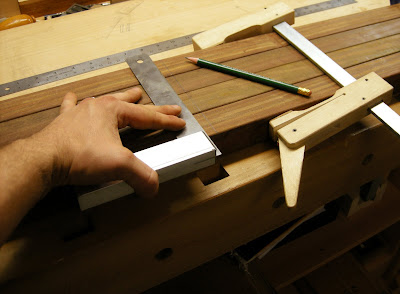 Whenever possible I like to lay out my joinery in groupings ie: the legs get clamped together and the mortises for the cross stretchers are laid out together. This will help keep things consistent and insure continuity between the pieces. I use a pencil to mark off the thickness of each component and then a deep scribe line with my knife for the joinery.
Mortise and Tenons
 All of the joinery for the bench frame is mortise and tenon except the front legs into the top apron by way of the slip joint.(refer back to part 3) The Ipe is close to 1 1/2" square so Ill follow the rule of thirds and lay out 1/2" mortises. I begin at the top of the back legs where they meet the bench top. I saw a tenon into the rear leg tops and chop out the mating mortises. Over in my shoulder vise I get out my favourite back saw and make some dust. You may notice in the pictures my set up for sawing the tenons- I hold them in the tail vise and have my bench hook next to it on my bench top. This is an efficient set up when you have a lot of tenons to cut. I start by ripping down the two cheeks and then turn the workpiece and rip the other two shoulder cuts. Then its a simple matter of unclamping and sawing at the bench hook without ever having to take a step. Ill get both tenons cut and then back into the tail vise to pare down to the scribe lines.

Ive heard some woodworkers say you should saw right to your scribe lines and I suppose in a perfect world this is true. I unfortunately live a few blocks East of a perfect world so I try to leave a bit of material to pare away to. This is especially true on the cross cuts where I want a crisp shoulder line.

With the tenons cut Ill forget that measuring tapes were ever invented and use the actual work piece to lay out my mortises. Again, I begin with a pencil and mark out my perimeter and follow with a knife line to determine the actual mortise size.


I begin with a brace and bit and bore out the bulk of the material. These are relatively shallow, stub tenons so I trust my eye and bore down into the oak. For deeper tenons Ill wrap a piece of tape around the bit to show me the finished depth and for really special work pieces Ill actually make up a wooden collar that slips over the bit creating a built in depth stop. But as mentioned, today Im using my eyes.
 From there Ill use my mortising chisel to chop off the little wings left between auger bit holes and square up the ends. Ill clean out the bottom and get ready for a dry fit. The brace and bit method of cutting mortises is a fast and accurate method but I should also mention when you first lay out the mortise its a good idea to scribe in a center line. This will give a point of reference for the bit to find center when drilling. The first dry fit shows me that I need to remove a little meat off of the tenon. This is another one of those wood working myths- tenons dont have to look pretty! I know we see them in our favourite woodworking magazines, all crispy and shining like a new dime but really-?
They do need to be straight and they really should be square but besides that they can be as rough as you make em. Keeping that in mind I use a rasp to trim the tenons.

Its fast and easy and all of those scratch marks left behind will actually make for a better glue joint. Another dry fit and its on to the next one.
 The bench now has four legs standing proudly, although still inverted on my bench top- I decide to address the bottoms of the legs and the feet. Its a natural progression, but I dont give the sequence too much thought. I suppose you could cut all of the legs first and then move onto all of the stretchers... I enjoy watching a work piece come together and at the end of my work day I like to see what Ive accomplished. So I started with the legs and then onto the feet; at least Ill be able to stand the bench upright and get a sense of where things are going for tomorrow!
The process of cutting the mortise and tenons throughout the frame is pretty much the same system as described above. Pencil to scribe lines and then bore out the waste and.....whats that? The wood? Too hard?
Oh yeah, I almost forgot- the crazy-dense exotic wood from South America proved to be a little too hard for my auger bit so I wasnt able to remove the waste like I did in the Oak. Imagine, the quarter sawn white oak in the bench top is actually the friendlier softer wood! Thats saying a lot.
So instead of removing the waste with my brace and bit I resort to the crashing and bashing of the mortise chisel. It actually went pretty quickly. As hard as this wood is, it works pretty well and while chopping across the grain for the mortises, I exploited the brittle under tones of the Ipe. The tenons were done as described and before I knew it the legs and the feet are complete...at least for tonight. Next time Ill shape the feet and finish the frame. Stay tuned.

Read More..
I mentioned in the first post that Im using some off the shelf hardwood for the bench frame; this was great for my budget but not ideal for my hand tools. Because it was dimensioned at the mill (and I use that term very loosely) I have to re-dimension it all again before I can start laying out my joinery. Theyre definition of square must be a little different than mine!The Ipe is an extremely dense South American hardwood and is very unforgiving to hand tools- perfect irony isnt it? Here I am making a new sharpening bench and the wood species Im using is ripping the edges off of my plane irons so fast that Im going back and forth to my old sharpening area being reminded with each pass how much Im looking forward to having this new one! Some strange motivation I suppose?
With that I begin planing and dimensioning, sharpening and planing some more. The reverse grain is very unusual in this species, its tones and weight are similar to teak but the dust coming off of it is Kermit the frog green...If youre ever using Ipe with power tools make sure you wear a mask! Im finding the small amount of dust coming off while hand planing a little irritating to my nose and throat. When I have all of the frame components cross cut to length (including joinery) and all surfaced, I can begin my layout.
Whenever possible I like to lay out my joinery in groupings ie: the legs get clamped together and the mortises for the cross stretchers are laid out together. This will help keep things consistent and insure continuity between the pieces. I use a pencil to mark off the thickness of each component and then a deep scribe line with my knife for the joinery. Mortise and Tenons
All of the joinery for the bench frame is mortise and tenon except the front legs into the top apron by way of the slip joint.(refer back to part 3) The Ipe is close to 1 1/2" square so Ill follow the rule of thirds and lay out 1/2" mortises. I begin at the top of the back legs where they meet the bench top. I saw a tenon into the rear leg tops and chop out the mating mortises. Over in my shoulder vise I get out my favourite back saw and make some dust. You may notice in the pictures my set up for sawing the tenons- I hold them in the tail vise and have my bench hook next to it on my bench top. This is an efficient set up when you have a lot of tenons to cut. I start by ripping down the two cheeks and then turn the workpiece and rip the other two shoulder cuts. Then its a simple matter of unclamping and sawing at the bench hook without ever having to take a step. Ill get both tenons cut and then back into the tail vise to pare down to the scribe lines. Ive heard some woodworkers say you should saw right to your scribe lines and I suppose in a perfect world this is true. I unfortunately live a few blocks East of a perfect world so I try to leave a bit of material to pare away to. This is especially true on the cross cuts where I want a crisp shoulder line.
With the tenons cut Ill forget that measuring tapes were ever invented and use the actual work piece to lay out my mortises. Again, I begin with a pencil and mark out my perimeter and follow with a knife line to determine the actual mortise size.
I begin with a brace and bit and bore out the bulk of the material. These are relatively shallow, stub tenons so I trust my eye and bore down into the oak. For deeper tenons Ill wrap a piece of tape around the bit to show me the finished depth and for really special work pieces Ill actually make up a wooden collar that slips over the bit creating a built in depth stop. But as mentioned, today Im using my eyes.
From there Ill use my mortising chisel to chop off the little wings left between auger bit holes and square up the ends. Ill clean out the bottom and get ready for a dry fit. The brace and bit method of cutting mortises is a fast and accurate method but I should also mention when you first lay out the mortise its a good idea to scribe in a center line. This will give a point of reference for the bit to find center when drilling. The first dry fit shows me that I need to remove a little meat off of the tenon. This is another one of those wood working myths- tenons dont have to look pretty! I know we see them in our favourite woodworking magazines, all crispy and shining like a new dime but really-? They do need to be straight and they really should be square but besides that they can be as rough as you make em. Keeping that in mind I use a rasp to trim the tenons.
Its fast and easy and all of those scratch marks left behind will actually make for a better glue joint. Another dry fit and its on to the next one.
The bench now has four legs standing proudly, although still inverted on my bench top- I decide to address the bottoms of the legs and the feet. Its a natural progression, but I dont give the sequence too much thought. I suppose you could cut all of the legs first and then move onto all of the stretchers... I enjoy watching a work piece come together and at the end of my work day I like to see what Ive accomplished. So I started with the legs and then onto the feet; at least Ill be able to stand the bench upright and get a sense of where things are going for tomorrow!The process of cutting the mortise and tenons throughout the frame is pretty much the same system as described above. Pencil to scribe lines and then bore out the waste and.....whats that? The wood? Too hard?
Oh yeah, I almost forgot- the crazy-dense exotic wood from South America proved to be a little too hard for my auger bit so I wasnt able to remove the waste like I did in the Oak. Imagine, the quarter sawn white oak in the bench top is actually the friendlier softer wood! Thats saying a lot.
So instead of removing the waste with my brace and bit I resort to the crashing and bashing of the mortise chisel. It actually went pretty quickly. As hard as this wood is, it works pretty well and while chopping across the grain for the mortises, I exploited the brittle under tones of the Ipe. The tenons were done as described and before I knew it the legs and the feet are complete...at least for tonight. Next time Ill shape the feet and finish the frame. Stay tuned.
Thursday, January 23, 2014
A House In The Trees Part II
Once the first two (2) bolts were in and I’d cleaned up from the first day of the tree house build, I walked the site and thought about how I would lay out the platform. As part of this process, I measured between the trees and discovered that the clearances between trees were 9’11” (too big for my intended 10’ beam) 12’6” (too big for my intended 12’ beam) and 15’7” (too big for my 16’ beam). Ungh.
Initially, I thought I’d just get two 2”x8”x18’ boards and make an 18’ beam. If I did that and discarded the 10’ one I’d already made, I could shift the other two down in location and still end up with the triangle shaped platform I had in my head.
In the morning, before going out to get the 18’ boards and walked the site again, with a slightly clearer head. While an 18’ beam would allow me to make the triangle shaped platform I’d intended, as I stood there between the trees I realized that the triangle was going to be too small. If I added a post to act as a fourth tree, I could turn the triangle into a rectangle and just about double the size of the tree house platform.
With this new plan, I headed to the store and picked up two (2) 2”x8”x16’ board to make a second beam for the long side and two (2) 2”x8”x10’ boards to make a second beam for the short end. I also picked up a 4”x4”x12’ post for the fourth “tree.”
As soon as I got home I again glued up the joists. Then I set to work marking out and digging for the post. To my astonishment and delight, I managed to dig the 3’5” hole for the post without hitting any roots, rocks or other impediments.
I tossed a few inches of gravel in the bottom of the hole to help with drainage and tossed in the post. After temporarily bracing the post level, I slowly filled the hole with dry cement. Every few inches I would tamp it down with a broom handle (on which I’d cut a flat end instead of the original rounded end) and added a bit of water with a watering can. Years ago I read somewhere that when setting posts you didn’t need to actually mix the cement, but could get away just watering it in place. I’ve used this method a few times now, and it seems to work fine.
With the post in place, I again thought about the beam layout and how I would frame and deck the platform. I realized that since the double 16’ beams would extend past the trees and pick up the weight of all of the joists, the double 12” beams at the end wouldn’t add anything but weight. At least I’ll be able to use two (2) of the five (5) beams I’ve made.
Other Tree House posts.
Read More..
Initially, I thought I’d just get two 2”x8”x18’ boards and make an 18’ beam. If I did that and discarded the 10’ one I’d already made, I could shift the other two down in location and still end up with the triangle shaped platform I had in my head.
In the morning, before going out to get the 18’ boards and walked the site again, with a slightly clearer head. While an 18’ beam would allow me to make the triangle shaped platform I’d intended, as I stood there between the trees I realized that the triangle was going to be too small. If I added a post to act as a fourth tree, I could turn the triangle into a rectangle and just about double the size of the tree house platform.
With this new plan, I headed to the store and picked up two (2) 2”x8”x16’ board to make a second beam for the long side and two (2) 2”x8”x10’ boards to make a second beam for the short end. I also picked up a 4”x4”x12’ post for the fourth “tree.”
 |
| Additional beams during glueup. |
 |
| The easiest hole Ive ever dug. |
 |
| The four trees for the Tree House. |
Other Tree House posts.
Subscribe to:
Posts (Atom)